What Actually Ranks a Local Business in 2026: The Data Behind Map Pack, Organic, and AI Search

Every year, Whitespark publishes the Local Search Ranking Factors report, run by founder Darren Shaw. It is the closest thing local SEO has to an industry consensus.
The 2026 edition surveyed 47 practitioners scoring 187 individual ranking factors. The study was started by David Mihm in 2008 and Shaw took it over in 2017.
Here is what the current data says, and what it means if you own a local business and want the phone to ring.
The three results are not the same game
Most business owners think about Google as one thing. It is not. There are three separate places a local business can show up, and each one rewards something different.
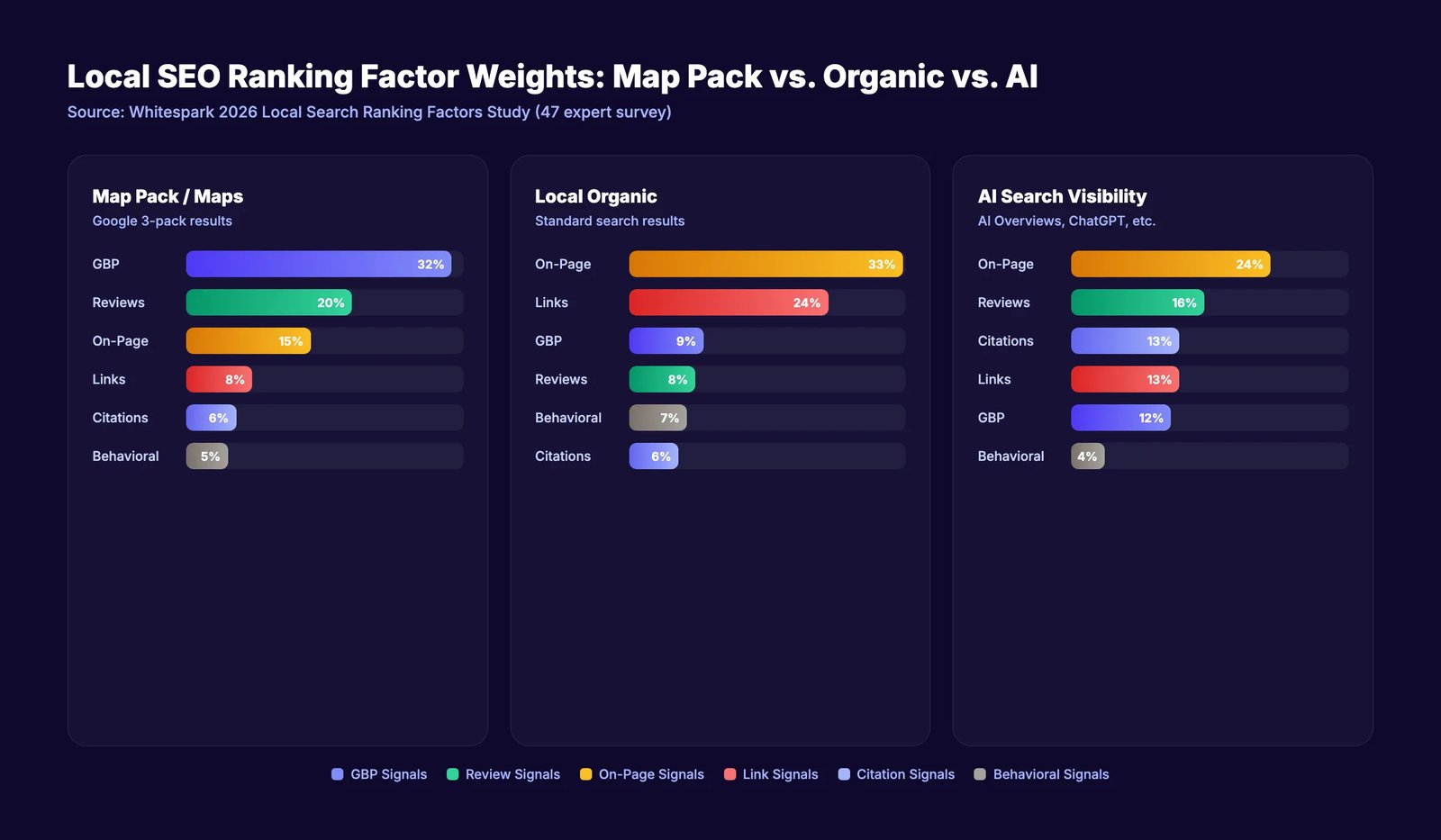
Map pack and Maps
The three results with the map above them.
- Google Business Profile signals: 32 percent
- Review signals: 20 percent
- On-page signals: 15 percent
- Link signals: 8 percent
- Citation signals: 6 percent
- Behavioral signals: 5 percent
Your Google Business Profile and your reviews account for more than half of what decides this. Your website matters, but it is a supporting player.
Local organic
The regular blue links under the map.
- On-page signals: 33 percent
- Link signals: 24 percent
- Google Business Profile signals: 9 percent
- Review signals: 8 percent
- Behavioral signals: 7 percent
- Citation signals: 6 percent
Here it flips entirely. Your website and the links pointing at it carry 57 percent. Your Business Profile barely moves this one.
AI search visibility
AI Overviews, ChatGPT, and similar.
- On-page signals: 24 percent
- Review signals: 16 percent
- Citation signals: 13 percent
- Link signals: 13 percent
- Google Business Profile signals: 12 percent
- Behavioral signals: 4 percent
The most evenly distributed of the three. Nothing dominates, which means AI visibility is earned by being consistently correct everywhere rather than by maxing out one channel.
What this means in practice
You cannot win the map pack with a better website. We see this constantly. A business invests in a beautiful new site and nothing changes in the map results, because 52 percent of that ranking comes from the profile and the reviews. If the map pack is where your customers are, that is where the work belongs.
You cannot win organic with a better profile. The reverse is just as true. Optimizing your Business Profile does almost nothing for the blue links, where your profile is worth 9 percent. Organic is won with service pages, content, and links.
Key Takeaway
Reviews are the only factor that matters everywhere. Twenty percent of the map pack, 16 percent of AI visibility, 8 percent of organic. If you have one thing to fix and limited time, this is usually it.
Reviews are the only factor that matters everywhere
Twenty percent of the map pack, 16 percent of AI visibility, 8 percent of organic. No other signal is that consistent across all three. If you have one thing to fix and limited time, this is usually it, and most local businesses are sitting on far fewer reviews than their competitors.
Citations came back
Citation signals score 13 percent for AI visibility, more than double their 6 percent weight in the map pack. AI systems appear to lean on directory consistency when deciding whether a business is real and what it does. That makes your name, address, and phone number matching exactly across every listing more valuable than it has been in years.
Dedicated service pages do heavy lifting
One of the clearest findings in the 2026 report is how much a dedicated page for each individual service matters, ranking at the top for both local organic and AI visibility. A single page listing all twelve of your services does not compete with twelve pages each covering one.
Where to start
If you are a local business trying to decide where to spend money this quarter, the order usually looks like this.
- Start with reviews, because it is the only lever that lifts all three result types at once and it is almost always the weakest point.
- Then fix your Business Profile completely, since category selection, services, hours, and photos are the single heaviest input to map pack ranking.
- Then clean up your citations so your information matches everywhere.
- Then build out individual service pages on your website.
That order changes if your customers are not searching the map pack. A business selling to other businesses, or one whose customers research before they call, may need the website work first. The point is not to follow a universal checklist. It is to know which result you are actually competing in and spend accordingly.
Source
All ranking factor weights cited here come from the 2026 Local Search Ranking Factors report by Darren Shaw of Whitespark, based on a survey of 47 local search practitioners scoring 187 factors. The full study is available at whitespark.ca.
Want us to check where you stand?
We run a free visibility audit that looks at how your business shows up in the map pack, organic results, and AI tools, plus your listings across 34+ sites.
Get your free audit here and we will show you exactly where you stand.