Google Quietly Stopped Sending You Free Customers

Google is rebuilding search around keeping people inside Google, and for local business owners that changes where your next customer actually finds you.
If you own a local business, you have probably noticed something in the last year. Your Google rankings did not get worse, but the phone did not ring the way it used to. You show up. Nobody clicks.
That is not your imagination, and it is not your website's fault. Roughly 60% of Google searches now end without a single click to any website. People read the AI summary at the top and leave.
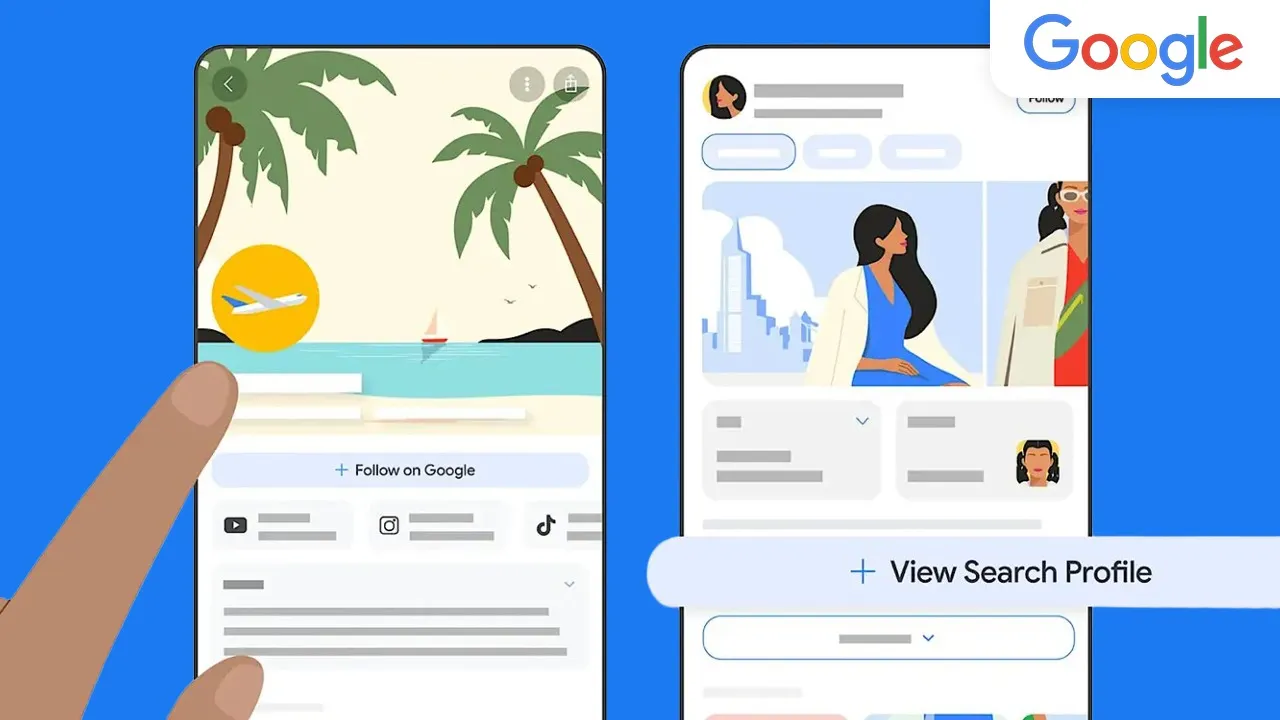
In June 2026, Google launched something called Search Profiles. Most coverage treated it as a creator story. I think it is a signal about where all of search is heading, and local businesses should be paying attention.
What Search Profiles actually are
A Search Profile is a claimable page inside Google Search that works like a social media profile. Avatar, bio, links to your website and socials, a pinned carousel of your short-form video from Instagram, TikTok and YouTube, and a grid of your latest posts and articles. There is a follow button on it.
Claiming one can trigger a knowledge panel if you do not already have one, and if you do, Google enhances the existing panel with your avatar, your latest content and a direct link to the profile.
Here is the part that matters, and that most people writing about this skipped. You almost certainly cannot get one.
| Requirement | Threshold at launch |
|---|---|
| YouTube subscribers | 100,000 |
| Instagram followers | 100,000 |
| X followers | 100,000 |
| TikTok followers | 300,000 |
| Age | 18 or older |
| Country | United States only |
It is open to publishers and creators with a sizable following on at least one major platform. A roofing company in Tampa does not qualify. Neither does a med spa, a chiropractor, or a law firm with 400 Instagram followers.
So why write about it?
The real story underneath it
Because of what the launch tells you about Google's direction.
Search Profiles pull a creator's content from Instagram, TikTok, YouTube and their website into a page that lives on Google. A searcher can follow them there. They never have to visit the creator's actual site or their actual social accounts.
That is the pattern. Google is building surfaces that answer the query and end the session inside Google.
AI Overviews did it to informational searches first. Someone types "why is my water heater leaking" and gets a full answer at the top of the page. The plumber who wrote the best article on water heater leaks gets the citation and, maybe, a click.
I want to be straight about one thing, because a lot of marketers are getting this wrong right now. Google's ad business is not dying. Search ad revenue is still growing in their reported earnings. What is shrinking is free organic traffic to your website. Those are two different things, and anyone telling you Google is collapsing is selling you something.
The pressure is real, it just is not coming from advertisers leaving. It is coming from the fact that people increasingly do not need to visit a website to get an answer, and from ChatGPT, Gemini and Claude taking over the queries that used to start on Google.
My read on where this goes
This next part is my opinion, not reported fact. I could be wrong about the timeline. I do not think I am wrong about the direction.
I think Google will generate fewer and fewer free customers for small local businesses every year from here. Not zero. Google Maps is not going anywhere, and when somebody needs a plumber at 11pm they are still opening Maps. But the long tail of searches that used to bring people to your website is being absorbed, first by AI Overviews, now by profiles and other in-Google surfaces.
At the same time, people are moving their questions to AI. They are not searching anymore, they are asking. "My back has hurt for three weeks, what should I do" instead of "chiropractor near me." The AI answers the question, and then it recommends somebody.
If that recommendation is not you, you were never in the running. There is no page two to be on.
That is why we changed how we work.
We moved from local-SEO-first to AEO-first
AEO stands for Answer Engine Optimization. Getting recommended by AI instead of ranked by a search engine.
For years our first ninety days with a client looked the same. Google Business Profile, keyword alignment, service pages, citations, reviews. Google first, everything else second.
We flipped it. Google Business Profile is still in there, it is still the backbone of Maps, but it is no longer where we start and no longer where the weight sits.
The reason is in the data. When researchers looked at what sources AI actually cites for local business recommendations, the picture did not match the Google-first playbook. Yelp appeared as a source in roughly 80% of ChatGPT's local answers. Google Business Profile dominates Google's own AI Overviews, but ChatGPT has no direct integration with it at all and pulls from Bing Places and other reputable sources instead.
OpenAI also licensed Yelp's reviews, ratings, photos and business details for ChatGPT's local recommendations, a deal disclosed in February 2026.
So if your entire local strategy is a beautiful Google Business Profile and nothing else, you are optimized for one of the three places your customers now look.
What AEO-first actually changes
Three things move to the front of the line.
Third-party listings where people leave reviews. Not because they send traffic. Most of them barely do. Because AI cross-checks your business across sources before it recommends you, and your reviews on those sources are what it reads. Yelp, Google, BBB, Apple Maps, Bing Places, and whatever directory is specific to your trade. Get on them, fill every field, and push reviews on all of them instead of only Google.
Here is a step most people skip. Ask ChatGPT, Claude and Gemini for the service you sell in your city, then look at the sources each one cites. That is the actual list for your industry. It is different for a chiropractor than for a roofer, and it is sitting right there in the answer.
Technical readability, but for bots instead of people. Schema markup so a machine can parse what you do, where you do it and what it costs. A verified site on Bing Webmaster Tools, since Bing feeds ChatGPT. A robots.txt that is not blocking OpenAI's crawler. Clean headings. Fast load. None of this is new, it is just that the audience changed from a human skimming to a model parsing.
Informational content over transactional content. This is the one that will feel wrong to most local business owners, so it gets its own section.
Teach them how to fix it themselves
Every business owner I say this to pushes back. Why would I write an article explaining how to fix a leaking water heater? I want to sell water heater repairs.
Because your customer is going to try to fix it themselves first. They always have. The difference is that twenty years ago they asked a neighbor, and now they ask AI.
So the question they type is not "water heater repair Tampa." It is "my water heater is leaking from the bottom, is that bad." The AI breaks that into smaller questions. Is it the tank or a fitting. How old is the unit. Is the leak from the pressure valve. Then it answers them, and then it tells them whether to call somebody.
If your website is the one that answered those questions, you are the one it tells them to call.
This is the part nobody wants to do, which is exactly why it works. Write down every small question you get asked on the phone before somebody hires you. Not the big ones. The small ones. Then answer them, in plain language, on your own site. You already know these answers cold. You explain them ten times a week.
Most of the people who read those answers will fix it themselves, and that is fine. They were never going to pay you. The ones who read it and realize the job is bigger than they thought already trust you by the time they pick up the phone.
Where to start this week
You do not need an agency to begin. Open ChatGPT and ask it for the service you sell in your city. See whether it says your name. Then look at the sources it cited, and get listed on every one of them.
That single afternoon puts you ahead of almost every competitor in your market, because almost none of them have done it.
The businesses that set this up now will own their category for a long time. Not because they are smarter. Because they did the boring work while everyone else was still arguing about whether AI matters.
If you would rather we handle it, tell us about your business and we will show you exactly where you stand across Google, Maps and AI before you decide anything.
Sources
- A new profile to help publishers and creators highlight their work on Search, Google, June 2026 — blog.google/products-and-platforms/products/search/a-new-profile-to-help-publishers-and-creators-highlight-their-work-on-search/
- Zero-click search research, SparkToro — sparktoro.com/blog/
- AI directory sources research, BrightLocal — brightlocal.com/resources/ai-directory-sources/
- ChatGPT local search data sources, Local Falcon — localfalcon.com/blog/chatgpt-local-search-data-sources-where-does-business-info-come-from
- Yelp and ChatGPT, WebFX — webfx.com/blog/ai/yelp-chatgpt/